Your search for frizzen returned 237 results.
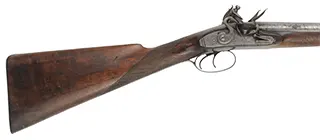
This English flint double shotgun is stocked in walnut and trimmed in iron furniture. The locks are marked E & W Bond. Edward Bond's company operated as E & W Bond from 1826 - 1854. The bright finished flintlocks have aged to a speckled patina. The Damascus barrels are fitted with hooked breeches and are mounted with a single wedge key. The barrel
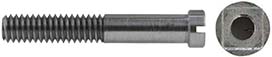
The inside mounted frizzen screw on a J. Kibler's Colonial flintlock, used on the Colonial, Woodsrunner, and Fowler models, requires a longer frizzen screw with a nut to mount a flash guard. Installation of an iron or brass flash guard, protects the shooter next to you from overspray vented from your flash hole. This protection is required at most-
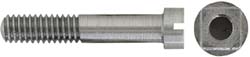
The inside mounted frizzen screw on a large Siler, deluxe Siler, Jim Chamber''s Golden Age, and Gunmaker's flintlock requires a longer frizzen screw with a nut to mount a flash guard. Installation of a iron or brass flash guard, protects the shooter next to you from overspray vented from your flash hole. This protection is required at most-re-enact
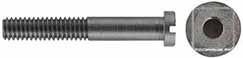
The inside mounted frizzen screw on a small Siler flintlock requires a longer frizzen screw with a nut to mount a flash guard. Installation of a iron or brass flash guard, protects the shooter next to you from overspray vented from your flash hole. This protection is required at most-re-enactments, where flint shooters may stand and fire volleys sh
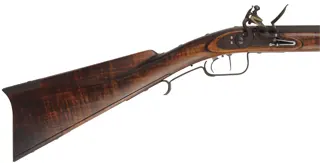
The unique style of Southern Mountain rifles originated from the Western Carolinas into Eastern Tennessee during the late 18th and early 19th century. This Southern Mountain rifle is stocked in curly maple and trimmed in iron furniture finished to a dark brown. Antique Southern Mountain rifles are often trimmed in iron furniture, with hardware stor
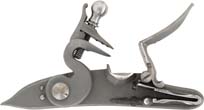
This large Colonial flint lock is ideal for an American longrifle or fowling gun, of the 1750-1770 era, with it’s large size and pointed tail. Assembled, tuned, and signed by R. E. Davis. Use is on an early longrifle, .50 to .62 caliber, with a simple brass or sliding wooden patchbox. Such “French & Indian War” era rifles are shown in Rifles of Col
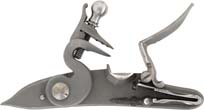
This large Colonial flint lock is ideal for an American longrifle or fowling gun, of the 1750-1770 era, with it’s large size and pointed tail. Assembled, tuned, and signed by R. E. Davis. Use is on an early longrifle, .50 to .62 caliber, with a simple brass or sliding wooden patchbox. Such “French & Indian War” era rifles are shown in Rifles of Col
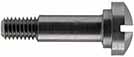
The outside mounted frizzen screw for Davide Pedersoli Kentucky Rifle or Pistol model locks is for use with Tedd Cash flash guards. Installation of a iron or brass flash guard, protects the shooter next to you from over spray vented from your flash hole. This protection is required at most-re-enactments, where flint shooters may stand and fire voll
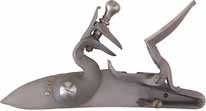
Queen Anne Fowling Gun Flint Lock, by L&R This attractive early English flint lock has a round faced cock and plate, and rounded frizzen and pan surfaces. Ideal for use on early English or American longrifles and fowlers of the 1730 - 1770 era, it will make a fine Chief’s grade trade gun lock, too. Sometimes called a “James Barbar” lock, after that
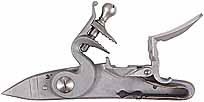
American Classic longrifle flint lock, right hand, by L&R New competition for the Siler lock, L&R’s new “Germanic” lock is for use on classic American longrifles of the 1760-1800 era. It is made to fit large Siler lock mortise. The cam action angle of the tumbler engages the mainspring. This really speeds lock time. Turned bearing surfaces on the t
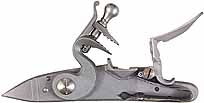
American Early Classic right longrifle Flint Lock, by L&R New competition for the Siler lock, L&R’s new “Germanic” lock is for use on classic American longrifles of the 1760-1800 era. It is made to fit large Siler lock mortise. The cam action angle of the tumbler engages the mainspring. This really speeds lock time. Turned bearing surfaces on the t
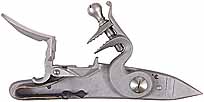
American Classic left longrifle Flint Lock, by L&R New competition for the Siler lock, L&R’s new “Germanic” lock is for use on classic American longrifles of the 1760-1800 era. It is made to fit large Siler lock mortise. The cam action angle of the tumbler engages the mainspring. This really speeds lock time. Turned bearing surfaces on the tumbler
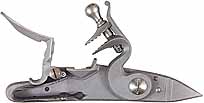
American Early Classic left longrifle Flint Lock, by L&R New competition for the Siler lock, L&R’s new “Germanic” lock is for use on classic American longrifles of the 1760-1800 era. It is made to fit large Siler lock mortise. The cam action angle of the tumbler engages the mainspring. This really speeds lock time. Turned bearing surfaces on the tu
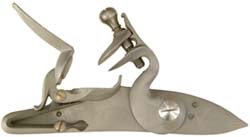
Fowling Gun Flint Lock, left, by L&R This left hand early English style flint lock has a round faced cock and plate, rounded frizzen and pan surfaces. It matches our right hand lock, and may be used on early double guns. Ideal for use on early English or American longrifles and fowlers of the 1730 - 1770 era. It will make a fine left hand trade gun
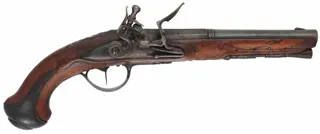
This unsigned holster pistol appears to French in style. The pistol is stocked in European walnut and trimmed in steel furniture with bone sideplates. The iron furniture has aged to a dark brown patina. The round faced flintlock has been reconverted to flintlock with a modern cock assembly, pan, and frizzen. The octagon-to-round barrel has a silver
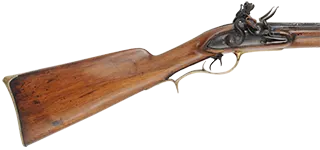
This reconverted double flintlock shotgun is stocked in walnut. The shotgun appears to have seen considerable use and was originally flintlock, converted to percussion, and has been converted back to flintlock. The Damascus barrels are 30-1/2" and have aged to a dark brown. The breech of the barrels is decorated with inlaid vine designs along the r
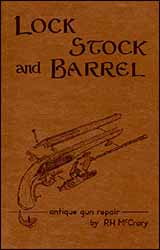
Practically every repair or restoration problem encountered with the muzzleloading gun is addressed. A partial list of topics include: Stock repair shows several typical damages, breaks, gouges, missing wood, illustrated and repaired. Wood finishing, cleaning, refinishing, spot finishing after local repairs. General information on metals, basics ab
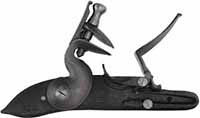
1746 - Willits, Brown Bess Musket Flint Lock Kit This lock kit is now fully assembled, tested for correct function, not polished. These First Model Brown Bess lock parts are cast directly from an original antique lock, by Willits - 1746. Parts are precision CNC machined, tempered, fitted and assembled. Overal length 6.68" by 1.18" tall. The mainspr
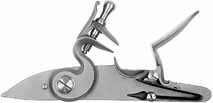
Early Ketland Flint Lock This flat faced English flint lock is made in the style of the early work of Thomas Ketland, for use on traditional American longrifles and English fowling guns of the 1750-1780 era. Unmarked, you might engrave KETLAND in block letters ahead of the cock, as many old locks were marked. A few locks also had simple floral engr
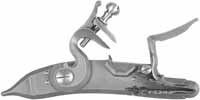
This nice large flint lock is distinctly “Germanic” style for use on transitional American longrifles of the 1750-1760 era. This lock is made for Track, by the R. E. Davis Company. Intended for use on “transitional” longrifles, so-called because they fit midway between the early short barreled “Jaeger” hunting rifles, and the classic longrifles we
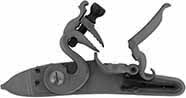
Durs Egg - London right Flint Lock Perhaps London's most innovative lock and gun maker, Mr. Durs Egg immigrated from Switzerland, setting up shop in London, the world's arms making center in his time. Actually, “Durs" was a nickname, but Mr. Egg adopted it as his own. We are glad he did. Once you have used this lock, you will never confuse the “Dur
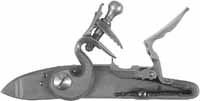
This fine lock is the correct “Germanic” style for use on classic American longrifles of the 1760 - 1800 era. Made in the style of Jacob Dickert, who worked in Lancaster county, Pennsylvania. More complex than the similar Siler lock, notice that the cock jaws point directly into the octagon pan. The unusual frizzen flange fits and seals the pan, ke
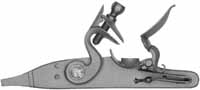
Studying the longrifles of Bedford County, Pennsylvania, might cause you to imagine that time nearly stopped in Bedford County, or that this region was isolated from the world. How can we explain why these men continued to make Bedford County rifles for over 120 years, much later than we might expect? How can we explain these very odd locks, with l
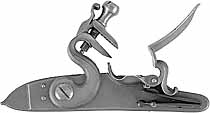
Fowling Gun Flint Lock - John Twigg, London This fine 1760 - 1770 era lock is made in the style of John Twigg. Famous for fowling guns, he made sporting rifles and pistols, too. Twigg's guns are generally very elegant, with minimal decoration. Rather, his eye for graceful architecture, and his use of subtle decorative features, enhanced his guns. L
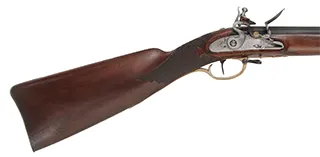
This antique European fowler appears to have Germanic origins. The walnut stock has a checkered wrist and scattered handling marks from decades of use. The left side of the buttstock displays well executed raised carving. The brass trim has developed a mellow patina, and the triggerguard is a modern replacement. The .60 caliber smoothbore is mostly