

The .40 caliber 42" barrel is swamped octagon and cut rifled by Rice Barrel Company with six deep radius bottom grooves with a 1 in 48" twist for a tightly patched round ball. Rice Muzzle Loading Rifle Barrels are set between centers and milled octagonal, insuring a centered bore. Each barrel is stress relieved in an atmosphere controlled electric furnace, to eliminate work hardening or barrel warp, and to dampen harmonic vibrations or barrel whip. After the rifling has been cut, each bore is "ball burnished". A carbide bore-sizing die is pulled through the barrel, to insure bore dimension uniformity, eliminating any tight or loose spots inside the barrel. This critical procedure leaves the top of the lands smooth and polished, equaling the traditional lead lapping procedure. Rice barrels are Match grade quality, with bench rest capability. Rice barrels do not require lapping or extensive shooting to break-in. The swamped octagon barrel is thickest at the breech for strength, tapers to a narrow waist to reduce weight, and flares at the muzzle to align the sights. The barrel is finished to a smooth chocolate brown. A brass blade front sight is dovetailed behind the muzzle and a flat top rear sight is dovetailed 10-1/2" ahead of the breech.
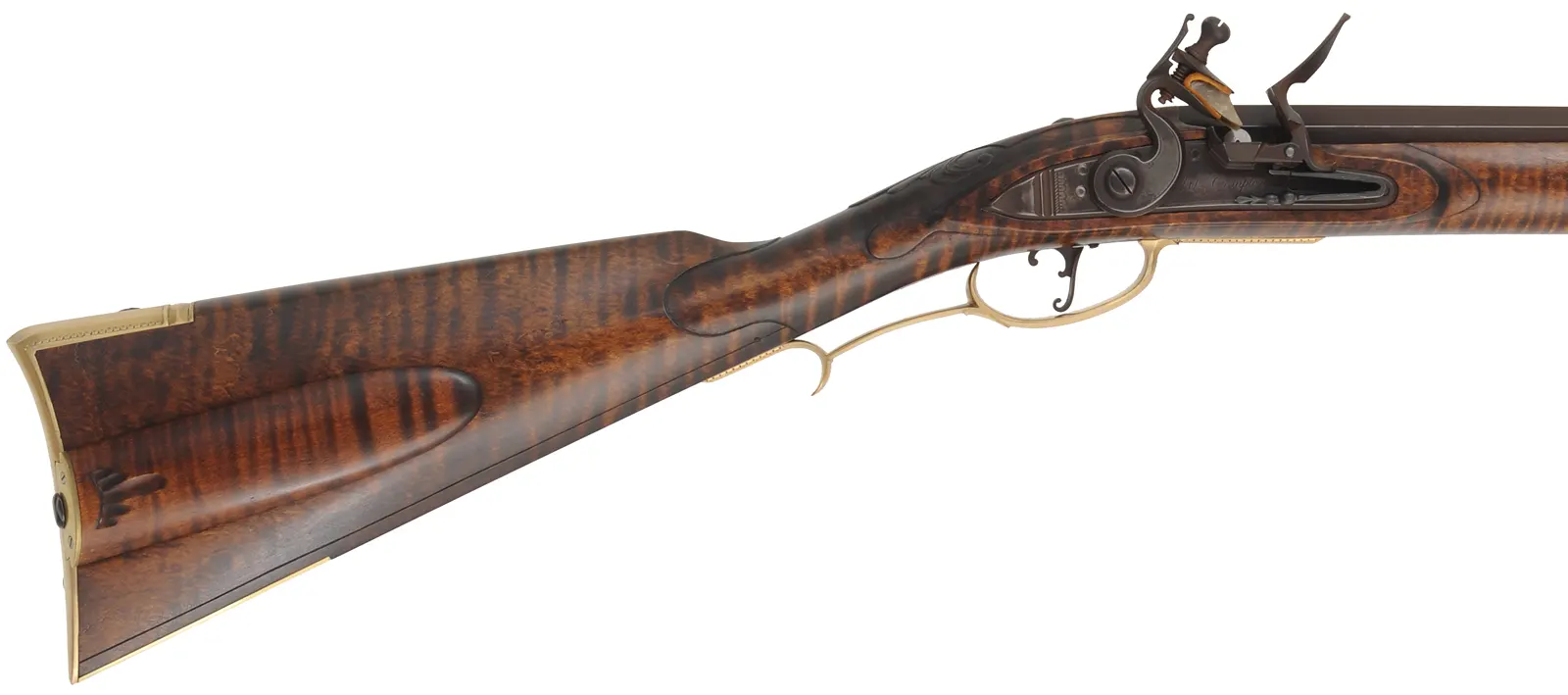
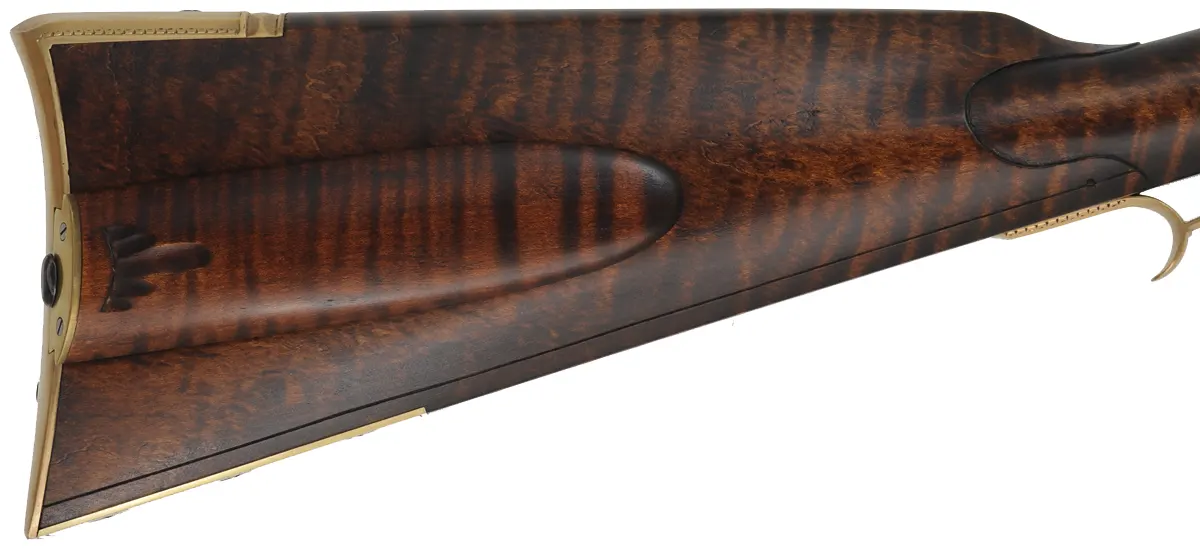
This rifle shows a blend of Germanic and English influence common on rifles from the York County, Pennsylvania region. The stock was stained to a whiskey brown with golden undertones to best display the beautiful figure. The bullet shaped patchbox is notched at the base with a thumb relief. To release the door, compress the spring toward the lid, and slide the door to the rear to reveal a deep cavity to store flints, jags, or other shooting accessories. The brass buttplate is well fitted to the stock and is offset or cast-off from the centerline of the rifle to put the shooter directly behind the line of the sights. The cheek is angled to the rear, to recoil away from your face. The buttplate comb is shaped with five octagon flats and a wedding band transition. Floral engraving on the center flat surrounds the buttplate screw. A line of incised carving runs from the buttplate to the rear of the triggerguard creating a slimming effect along the toe line. The lock panels are neatly shaped with a raised molding and large beaver tail finial. The front edge of the comb is defined by a line of raised carving flows down into the wrist. The top view shows the raised Fluer-de-Lys carving that surrounds the flared tang of the breech plug.
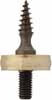
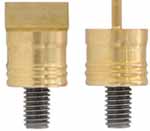
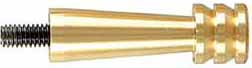
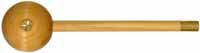
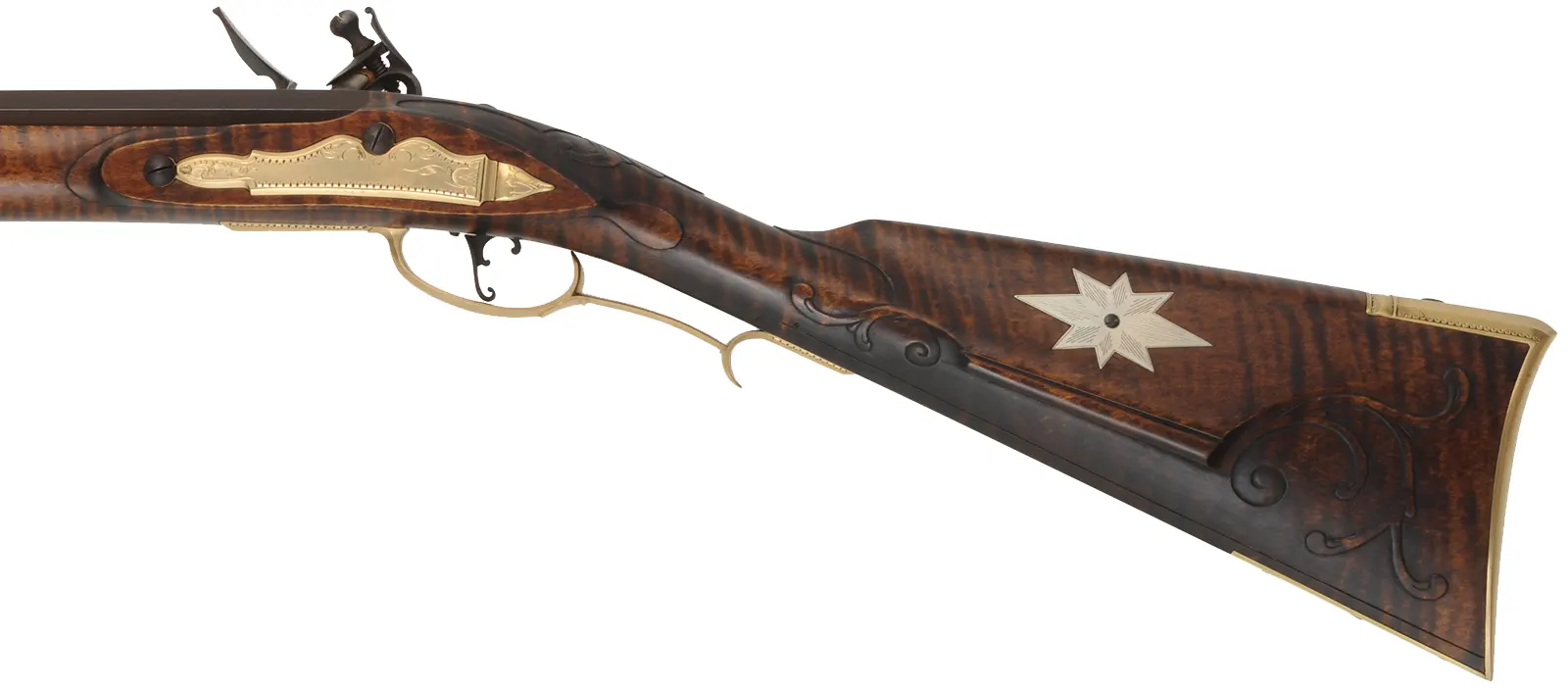
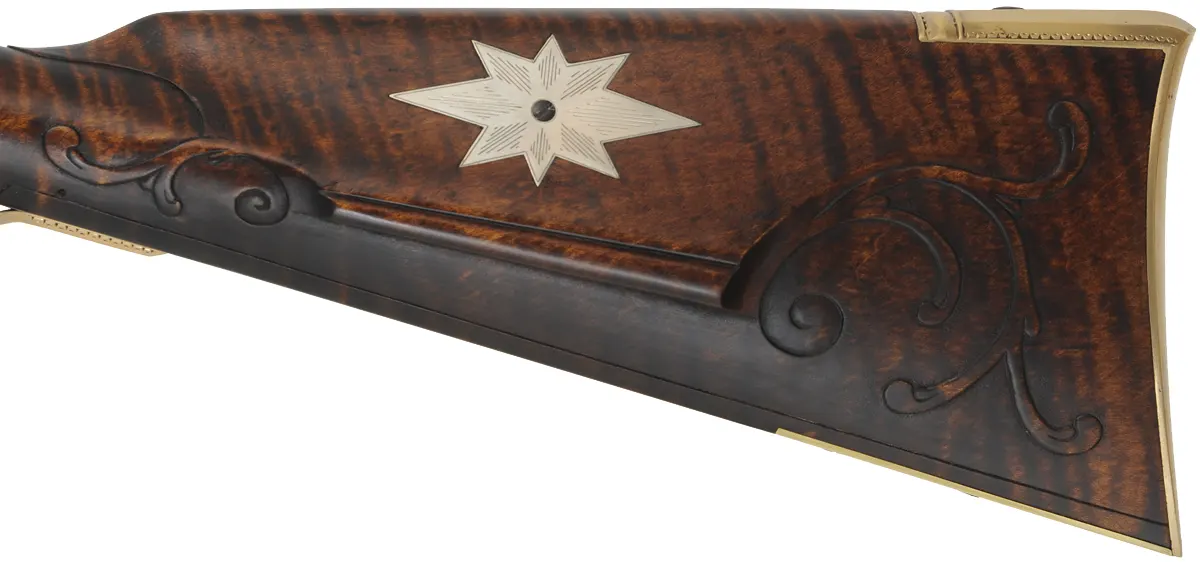
Our bottom view of the rifle shows off the engraved brass toeplate and triggerguard. The decorative toeplate is held in position by three screws that are surrounded by engraving. In addition to its decorative factor, the toeplate adds a level of protection to the wood. The brass triggerguard is pinned to the stock in traditional fashion and the bow is engraved with a floral design. A raised Fluer-de-Lys carving surrounds the pointed skirt of the ramrod entry pipe before transitioning into a raised molding that runs along the ramrod channel. A brass muzzle cap protects the end grain of the stock. The 3/8" diameter ramrod is fitted with a tapered steel tip with 8-32 threads to mount loading and cleaning accessories. The ramrod is held in place with two brass octagon shaped ramrod pipes with rings on each end, and matching entry pipe with engraved pointed skirt. A backside view of the rifle shows off the engraved brass English influenced sideplate with pointed tail. English style sideplates are often associated with neighboring York County, which was part of Lancaster County until 1749. Further back on the gun the classic squared cheek provides the shooter with a comfortable platform to align sights. The buttstock is carved with raised scrolls surrounding the cheek piece. An engraved hunter's star is neatly fitted to the cheek.
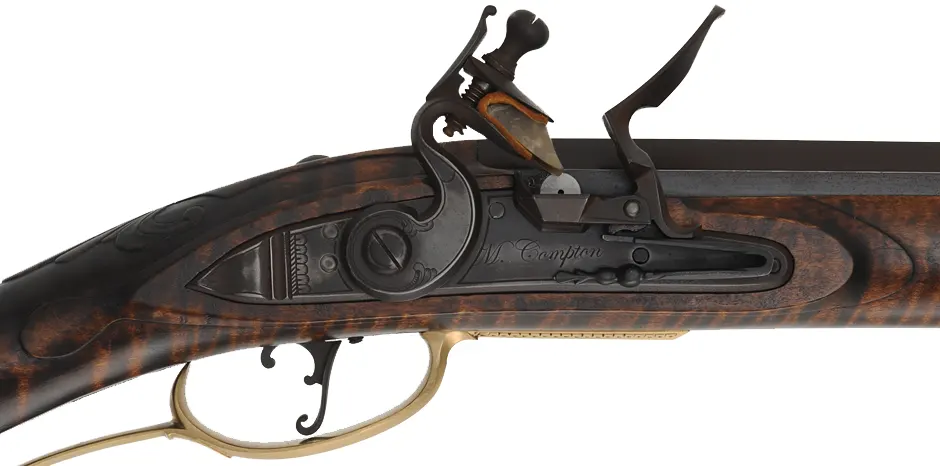
Ignition is provided by this Jim Chambers' deluxe Siler flintlock. The lock has a Germanic influence with a paneled pan and pointed tail with a vertical molding. The flint cock and lock plate are hand engraved with a border and floral design. The lock plate is signed M. Compton and the bottom of the pan is engraved #144. The lock sparks very well when combined with our 3/4" flints. Notice the stainless vent liner that has been installed on the rifle. This vent is perfectly positioned, well above the bottom of the pan. A vent serves as a window, allowing the heat of the flash to be instantly transmitted to the main charge. It should not be located low in the pan, serving as a drain, where it will slow ignition, causing the classic "whoosh - bang" delay often associated with flint longrifles. With this geometry, ignition appears to have no such delay. The single trigger located below the lock has been properly pinned into position. Giving good leverage against the sear it breaks crisply and cleanly at a very light weight.
In as-new unfired condition, this contemporary longrifle will be a joy to shoot! The lucky buyer will own a treasure that will last a lifetime, and his heirs will raise toasts to his good taste, far into the future. Order it for a ten day visual inspection. You will be delighted. Else if it does not fit you, return it in unfired condition for same-day refund. Postage is your only risk, when you order any one-of-a-kind gun from Track, whether new, used, or antique.
Ready to order? Click VIEW CART in the upper right of the screen, review items and quantities, then click CHECK OUT. Enter your name, address, and billing information for prompt shipment. Or, PRINT your order after entering your address, attach your check or money order, and send it by mail. Shipping cost is displayed after you enter your address.
Our web site displays actual in stock status, up-to-the-minute price, and shipping cost to every address in the USA and MOST OTHER COUNTRIES. International shipping cost for extra long or heavy parcels are determined after we weigh the parcel.
Ten day inspection begins at delivery. Send your approval. Else return it for same day refund, if not delighted. Postage is your only risk.
Related Products Shown Below