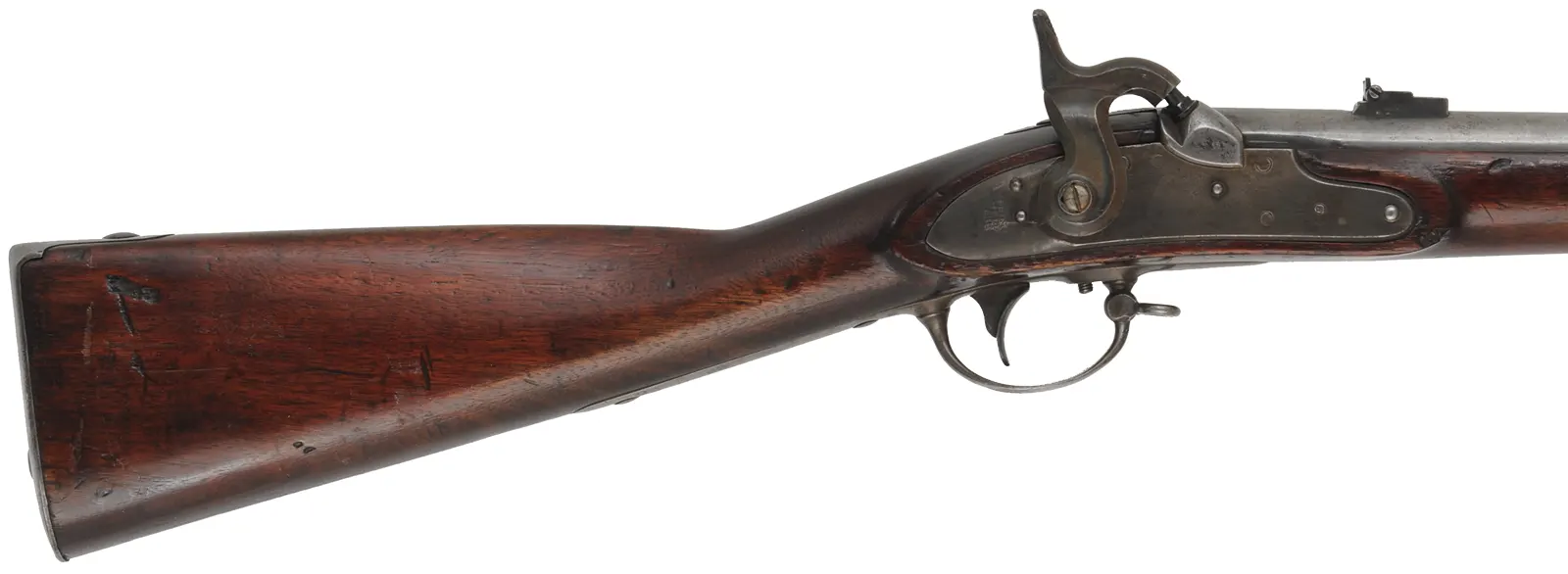


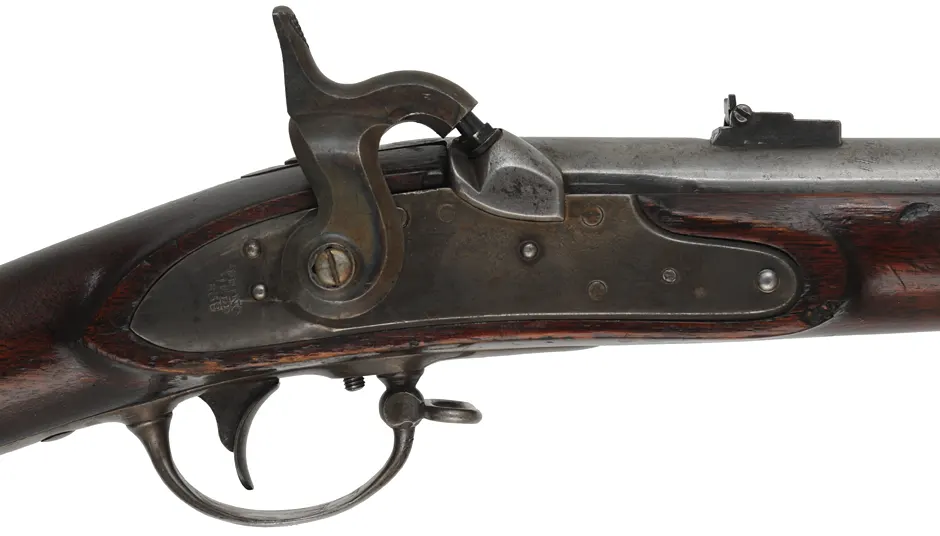
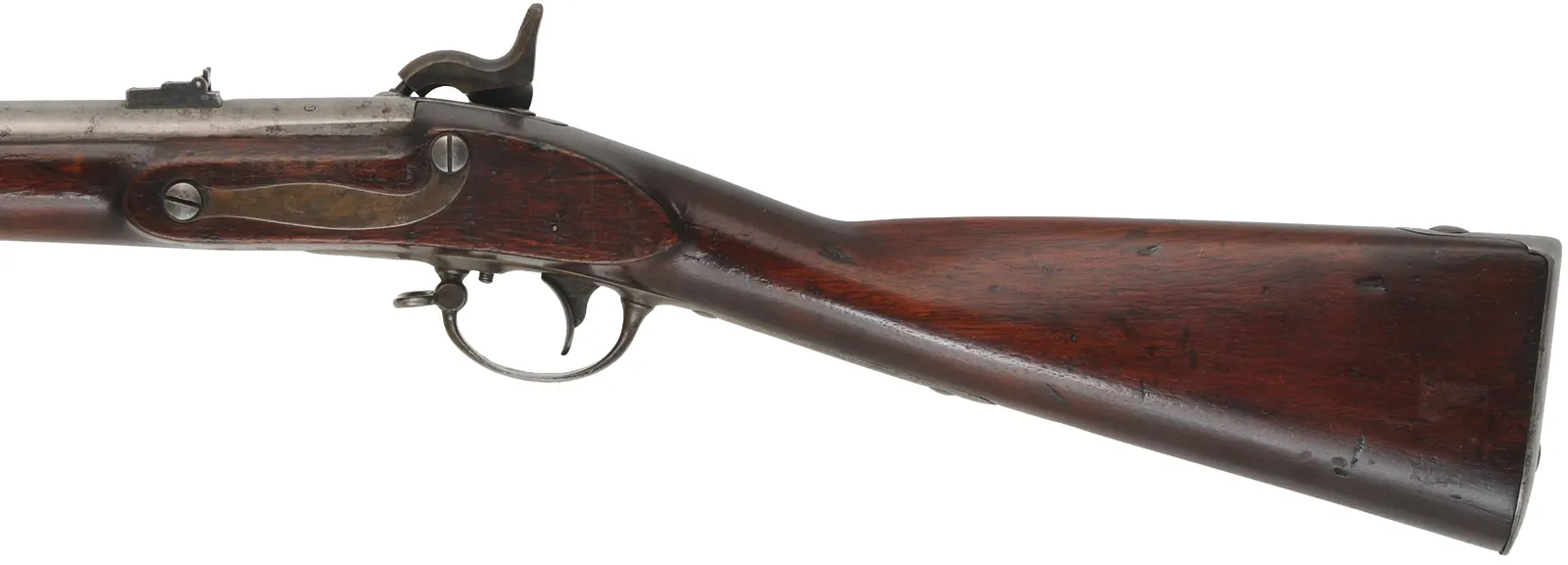
The .69 caliber smooth bore barrel was cut down to 29-1/2", including the breech. The bore measures .691" at the muzzle and is bright, clean, and shootable. The breech end of the barrel is stamped with a P proof mark, which was from the original proof testing. During the conversion to percussion, the breech end of the barrel was cut off and a new percussion breech was fitted. This appears to be a very well done period conversion by a professional contractor. A Springield three leaf rear sight was added when the barrel was shortened, and is mounted 2" ahead of the breech, with two leafs marked for 300 and 500 yards. The leaves would be calibrated for a full length .58 caliber rifled musket. Forward two barrel bands hold the barrel to the stock, the rearmost band is a single strap, while the front band is a double strap; the iron front sight is attached to the front strap of the forward band.
Stocked in walnut, this musketoon has many dents, dings, scratches, and scuff marks, but no visible cracks. The cartouche marks were removed when the musket was refinished during the conversion. The comb of the buttplate is stamped US just ahead of the screw. The iron furniture has developed a speckled brown gray patina. Our bottom view reveals the rounded toe of the walnut stock and the steel triggerguard. The toe of the buttstock is engraved with a previous owner's name in script. The front of the triggerguard finial is stamped SP and the rear sling swivel is mounted to the forward boss of the guard. No front swivel is fitted to the barrel bands. The metal ramrod easily slides through the barrel bands. The ramrod has a jagged slotted tip, rather that the typical period flared end. The front barrel band has a pin hole, but the barrel band spring in that position appear to an inverted middle spring with a pin stud. The front barrel band is pushed against that spring to friction fit. A military style steel sideplate is inlet flush into the stock, to accept the two lock bolts. The sideplate is stamped with an S inspection mark.
The lock plate has plugged holes from when the pan, frizzen, and spring were removed during the conversion from flint lock to percussion lock. Note the markings found on the tail of the lock, in three lines it reads SPRING / FIELD / 1839, giving the location and date of its manufacture. The top of the lock plate is stamped 901 just ahead of the bolster. The lock has a strong mainspring, with secure half and full cock notches. We note the hammer used in the conversion is from a U.S. Model 1863 rifled musket and the tumbler screw does not fully cover the square hole in the hammer. The hammer has a small amount of visible color case hardening. A modern musket nipple is fitted in the bolster, which is well supported by the lock plate.
This Model 1816 Musketoon conversion has a bright shootable bore. It would make a fine addition to an American Civil War collection, or to the reenactor who wants to carry and shoot an original musket. Order it for a ten day visual inspection. You will be delighted. Else if it does not fit you, return it in unfired condition for same-day refund. Postage is your only risk, when you order any one-of-a-kind gun from Track, whether new, used, or antique.
Ready to order? Click VIEW CART in the upper right of the screen, review items and quantities, then click CHECK OUT. Enter your name, address, and billing information for prompt shipment. Or, PRINT your order after entering your address, attach your check or money order, and send it by mail. Shipping cost is displayed after you enter your address.
Our web site displays actual in stock status, up-to-the-minute price, and shipping cost to every address in the USA and MOST OTHER COUNTRIES. International shipping cost for extra long or heavy parcels are determined after we weigh the parcel.
Ten day inspection begins at delivery. Send your approval. Else return it for same day refund, if not delighted. Postage is your only risk.