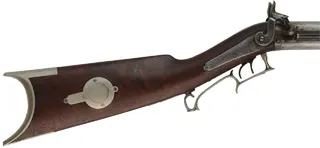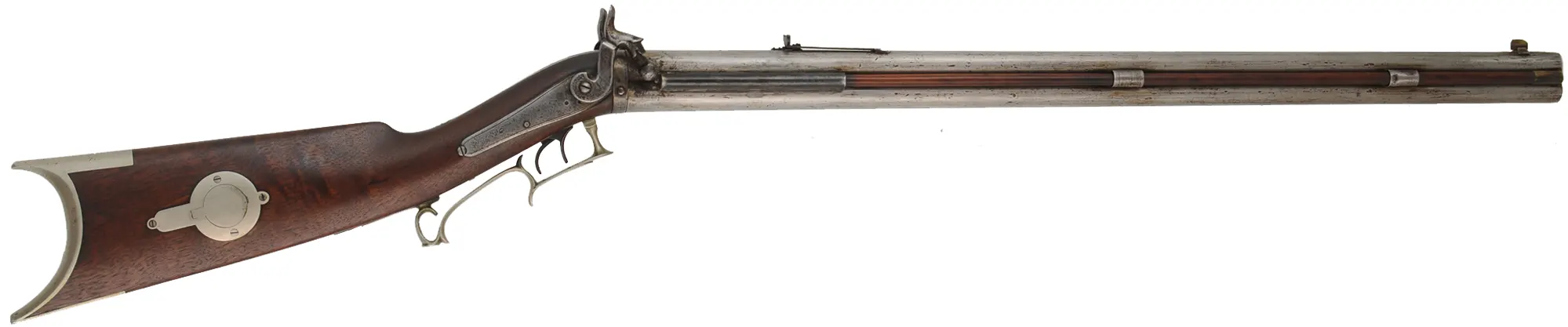
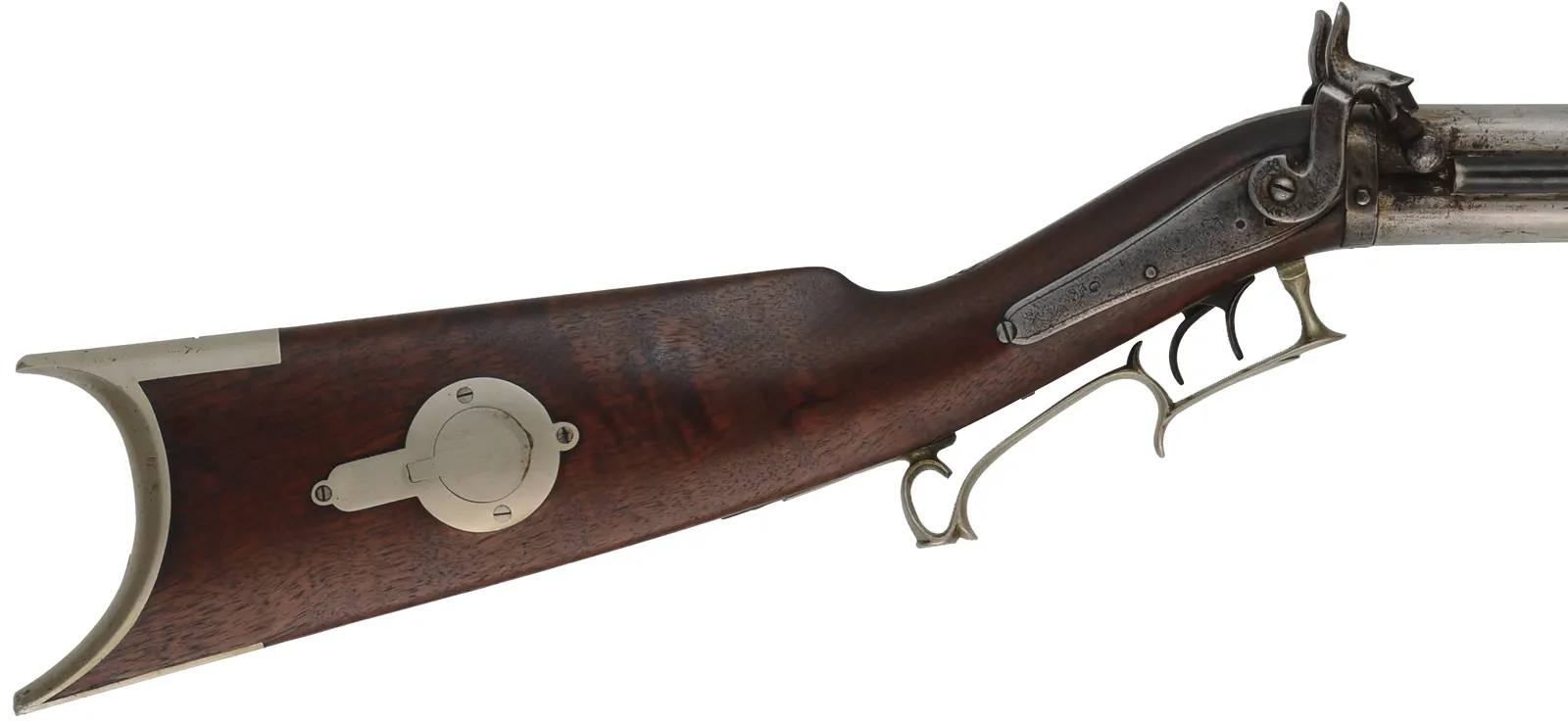



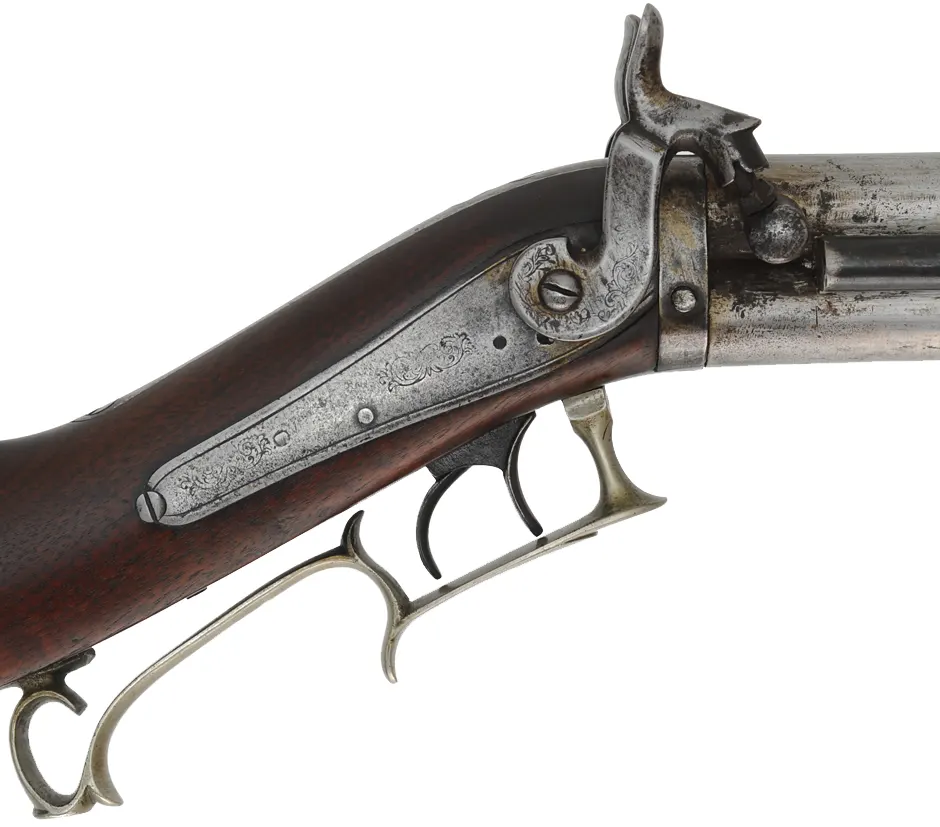
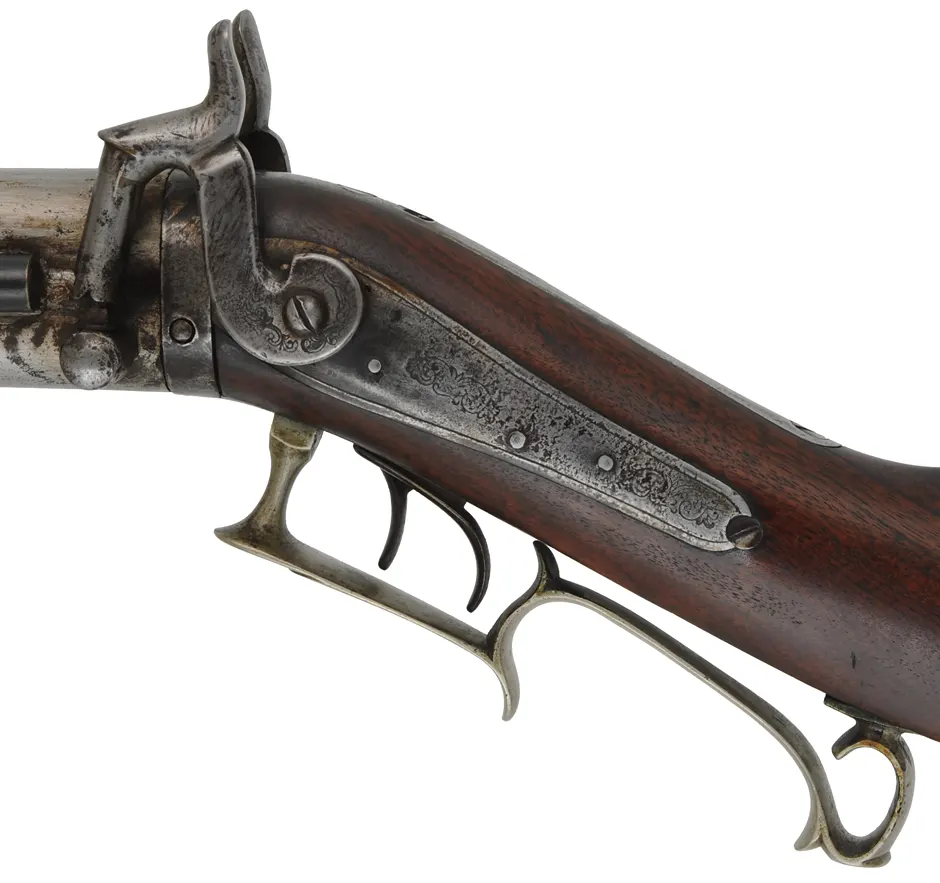
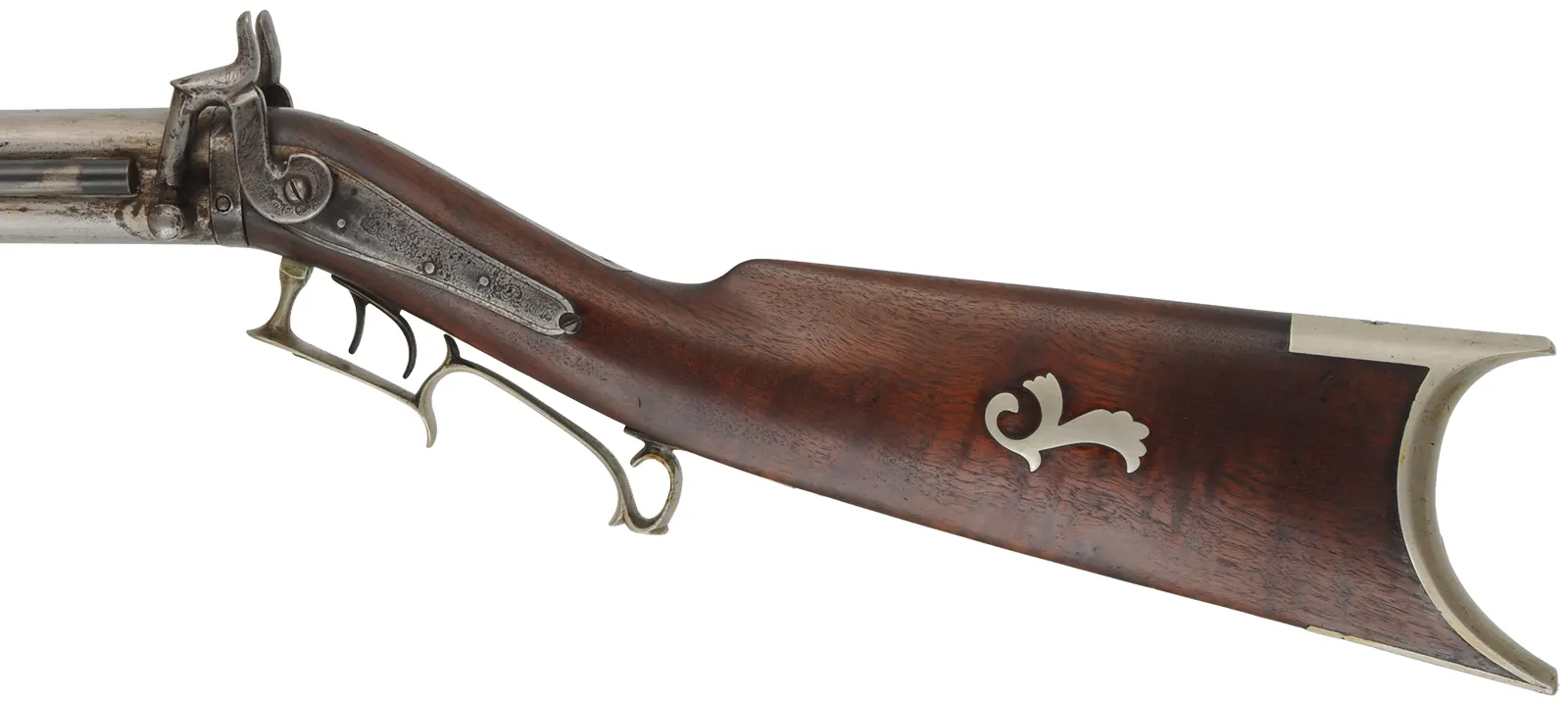
The percussion over under rifle was a popular design in mid ninetieth century America. They seem to most often be made by New York gunsmiths. Not often replicated today we have examined numerous antique examples of this style of rifle with a variety of construction techniques. This antique rifle is very neatly constructed and has the most typically encountered drum and nipple construction with the long "elephant trunk" nose added to the left hand hammer to reach down to the lower barrel. The walnut buttstock has nice shaping with a cap box, and crescent buttplate. The inletting on this rifle is exceptional. The back action percussion locks are marked with some die stamped designs. Trigger reach is 13-1/4" to the front trigger. Weight is 8.6 pounds.
Both barrels are .43 caliber with seven groove rifling and have mostly bright bores with some scattered pitting visible. The 27" barrels are tapered round to reduce muzzle weight. The top barrel is currently fitted with a step adjustable rear sight that partially covers the name. A brass blade front sight with integral base is dovetailed behind the muzzle. Both the front and rear sight appear to be much later additions to the rifle. The top of the barrel is marked L.L. Hepburn Colton NY. The Hepburn portion of the stamp is marked over another lighter marking on the barrel.
The buttstock has perch belly design in New England style and is fitted with a crescent buttplate. The sand cast buttplate is neatly filed flush with the buttplate comb. A nickel silver cap box is inlet flush. The wood on the stock has been sanded and the buttplate and capbox have been burnished bright. The stock has a very slender comb. The tang of the action extends down the wrist to add strength and reinforce this weakest point. The tang has a unfilled hole, and may have had a post style tang sight that is now missing. The stock has cast-off for a right hand shooter.
The toe is protected with a long toeplate mounted with two steel screws and a rivet to the buttplate. The toe has some dents and dings above the toeplate. The nickel silver triggerguard has a large open bow with finger spur and curled grip rail. This triggerguard is a period commercial casting and is encountered on many different rifles the the late 1840 to 1850 era. The left side of the stock has a nickel silver inlay fitted flush with the stock.
The ramrods are fitted through two ramrod pipes into a long skirt mounted to the breech end of the barrel. The left hand ramrod has a slight taper and reversible worm tip on the hidden end. The exposed end is fitted with a cartridge case turned into a tip. The right hand ramrod has a brass band on the exposed end and no fittings on the hidden end.
The back action locks are unmarked as to a maker and have a very basic border with die stamped designs. They locks have aged to a light speckled salt and pepper patina. The right hand lock will not reliablely engage the tumbler full cock notch. The left hand lock will not engage the full cock notch at all. We did not attempt to dismount the lock. The design of this rifle requires the left hand hammer to be pulled to access the bolt that secures both locks. The drums are fitted with antique nipples. We did not attempt to remove them.
This antique rifle has good solder joints, and no play at the breech. The locks would need attention if you plan to fire this rifle. As with any antique you plan to fire we recommend remotely firing your maximum load before shouldering it yourself.
Both barrels are .43 caliber with seven groove rifling and have mostly bright bores with some scattered pitting visible. The 27" barrels are tapered round to reduce muzzle weight. The top barrel is currently fitted with a step adjustable rear sight that partially covers the name. A brass blade front sight with integral base is dovetailed behind the muzzle. Both the front and rear sight appear to be much later additions to the rifle. The top of the barrel is marked L.L. Hepburn Colton NY. The Hepburn portion of the stamp is marked over another lighter marking on the barrel.
The buttstock has perch belly design in New England style and is fitted with a crescent buttplate. The sand cast buttplate is neatly filed flush with the buttplate comb. A nickel silver cap box is inlet flush. The wood on the stock has been sanded and the buttplate and capbox have been burnished bright. The stock has a very slender comb. The tang of the action extends down the wrist to add strength and reinforce this weakest point. The tang has a unfilled hole, and may have had a post style tang sight that is now missing. The stock has cast-off for a right hand shooter.
The toe is protected with a long toeplate mounted with two steel screws and a rivet to the buttplate. The toe has some dents and dings above the toeplate. The nickel silver triggerguard has a large open bow with finger spur and curled grip rail. This triggerguard is a period commercial casting and is encountered on many different rifles the the late 1840 to 1850 era. The left side of the stock has a nickel silver inlay fitted flush with the stock.
The ramrods are fitted through two ramrod pipes into a long skirt mounted to the breech end of the barrel. The left hand ramrod has a slight taper and reversible worm tip on the hidden end. The exposed end is fitted with a cartridge case turned into a tip. The right hand ramrod has a brass band on the exposed end and no fittings on the hidden end.
The back action locks are unmarked as to a maker and have a very basic border with die stamped designs. They locks have aged to a light speckled salt and pepper patina. The right hand lock will not reliablely engage the tumbler full cock notch. The left hand lock will not engage the full cock notch at all. We did not attempt to dismount the lock. The design of this rifle requires the left hand hammer to be pulled to access the bolt that secures both locks. The drums are fitted with antique nipples. We did not attempt to remove them.
This antique rifle has good solder joints, and no play at the breech. The locks would need attention if you plan to fire this rifle. As with any antique you plan to fire we recommend remotely firing your maximum load before shouldering it yourself.